Beyond the noticeable cosmetic defect, these conditions can be accompanied by impaired chest biomechanics, restricted chest expansion when breathing, reduced exercise tolerance, poor posture and considerable psychological and emotional distress.
International experience shows that, with timely diagnosis and the right choice of treatment, most children and adolescents can be treated effectively and conservatively, without surgery.
At Medicom, we use internationally recognised methods for the conservative correction of chest wall deformities:
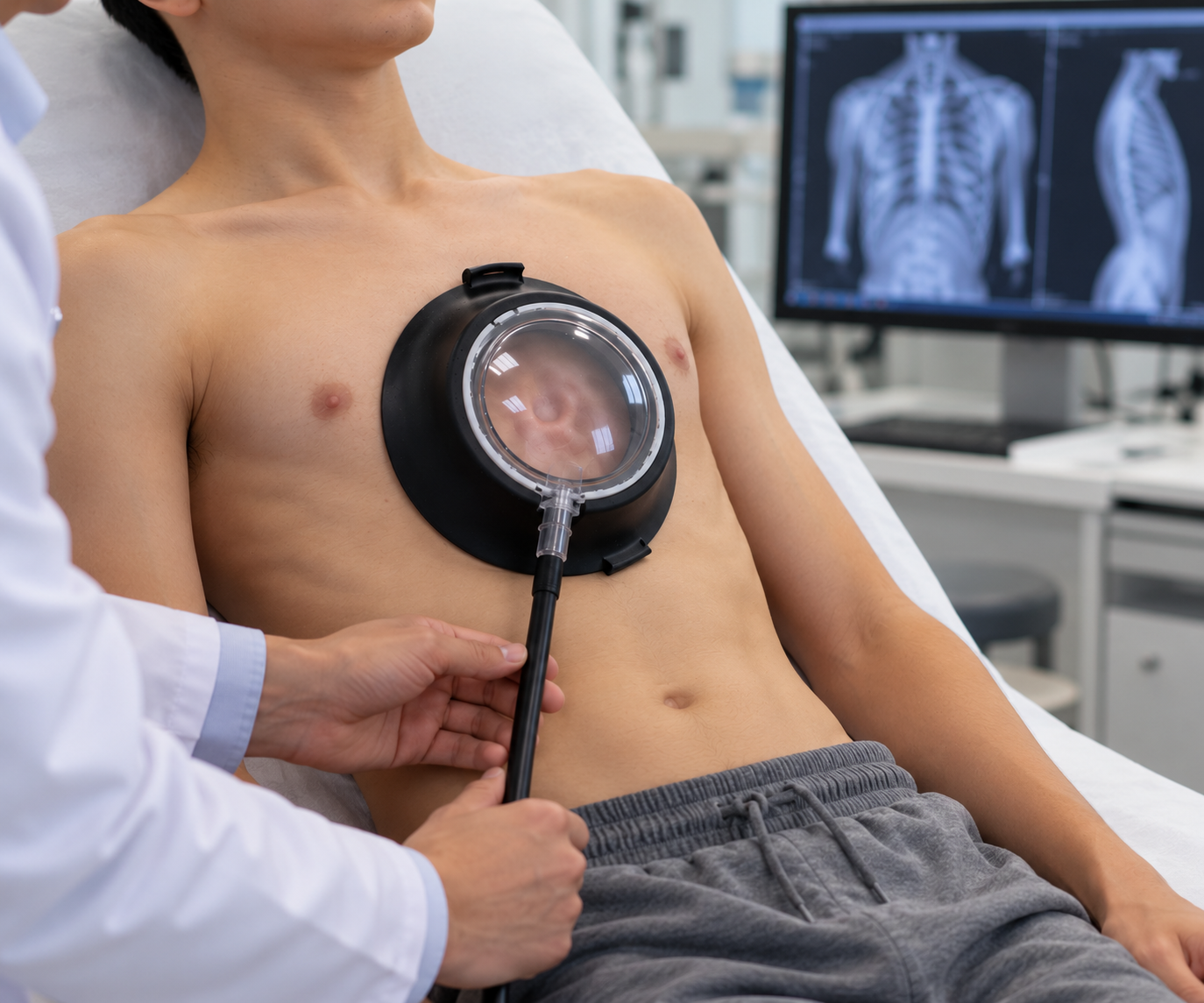
Vacuum Bell — for treating pectus excavatum;
Individually fitted compression brace — for treating pectus carinatum.
Every treatment programme is designed individually, taking into account the patient's age, the severity of the deformity, the flexibility of the chest wall and the potential for further growth.
Which Chest Wall Deformities Do We Treat?
Pectus Excavatum (Funnel Chest)
In pectus excavatum, the breastbone (sternum) and the adjoining sections of the ribs are sunken into the chest as a result of the way the costal cartilages develop.
Depending on its severity, the deformity may be accompanied by:
- a cosmetic defect
- reduced self-confidence
- poor posture
- discomfort during physical activity
- tiring more easily
- restricted chest expansion
Pectus Carinatum (Pigeon Chest)
In pectus carinatum, the breastbone and the front of the chest protrude excessively outwards.
The condition most often appears during periods of rapid growth in childhood and adolescence.
Its main signs are:
- a breastbone that sticks out
- an asymmetrical chest
- cosmetic concerns
- psychological difficulties related to appearance
- poor posture
Conservative Treatment of Pectus Excavatum
Correction with the Vacuum Bell System
The Vacuum Bell is a specialised medical device that creates controlled negative pressure over the area of the deformity.
Under the effect of the vacuum, the sternum gradually moves into its natural position, which in turn gradually corrects the shape of the chest.
It works best in children and adolescents, because the bone and cartilage structures of their chest are highly flexible.
Who Is the Vacuum Bell Suitable For?
The method is recommended for patients:
- with mild to moderate pectus excavatum
- who are still actively growing
- for whom surgery is not indicated
- whose chest wall is sufficiently flexible
Benefits of This Method
- Non-surgical treatment
- Non-invasive technique
- Can be used at home
- A high level of safety
- Gradual, physiological correction
- Minimal impact on everyday activities
Conservative Treatment of Pectus Carinatum
Individually Fitted Compression Brace
Pectus carinatum is treated with a specially designed brace that applies controlled, measured pressure to the protruding part of the chest.
This gradual, adjustable compression encourages remodelling of the bone and cartilage structures and progressively corrects the deformity.
Each brace is individually tailored to the patient's anatomy.
Who Is the Compression Brace Suitable For?
The method is recommended for:
- children and adolescents who are still actively growing
- patients with a flexible chest wall
- patients for whom surgery is not indicated
Benefits of This Method
- Non-surgical treatment
- Made individually for each patient
- Adjustable compression system
- Highly effective when treatment starts at the right time
- Comfortable to wear in everyday life
How Does Treatment Work?
How Does Pectus Carinatum Treatment Work?
-
Free Initial Consultation
Medicom specialists examine the patient, assess the severity of the deformity, the patient's age, chest wall flexibility and potential for further growth, and determine whether conservative treatment is possible.
-
Clinical Assessment and Anthropometric Measurements
During the examination, we carry out a comprehensive assessment of:
- the type of deformity
- the severity of the carinatum deformity
- chest symmetry
- the flexibility of the ribs and costal cartilages
- the patient's age and growth potential
We also take anthropometric measurements of the chest, which are needed to select a compression brace of the right size.
If necessary, the specialist may recommend additional diagnostic tests.
-
Choosing the Compression Brace
Unlike devices made entirely to an individual digital design, compression braces for pectus carinatum come in a range of standard sizes.
Based on the anthropometric measurements, the Medicom specialist selects the brace that best matches the anatomy of the patient's chest and then adjusts it individually.
-
Individual Brace Adjustment
Once the brace has been selected, it is adapted to the individual patient.
Our specialists check:
- that the compression pad is correctly positioned
- the amount of pressure applied
- the stability of the brace
- the patient's comfort
- how effective the compression is
Where necessary, the compression system is adjusted further to achieve the optimal therapeutic effect.
-
Ongoing Monitoring
Throughout the course of treatment, Medicom specialists carry out regular check-ups, track how the deformity is responding to correction and, where necessary, adjust the level of compression in line with the child's growth and the results of treatment.
Technologies We Use
In the conservative treatment of chest wall deformities, Medicom uses modern international techniques based on the principles of evidence-based medicine.
Depending on the type of deformity, we use:
- the Vacuum Bell system for pectus excavatum
- modern adjustable compression braces for pectus carinatum
- clinical assessment and anthropometric measurements of the chest
- individual adjustment of compression systems
- ongoing monitoring of treatment effectiveness
This allows us to choose the most effective treatment strategy for each patient and to ensure safe, physiological correction of the deformity without surgery.
Why Choose Medicom?
- More than 20 years of professional experience
- International standards of conservative treatment
- Every device made individually
- Free initial consultation
- Outreach consultations for patients in remote regions
- Regular follow-up monitoring
- Full support throughout the entire course of treatment
Duration of Treatment
The duration of conservative treatment is determined individually and depends on:
- the patient's age
- the type of deformity
- its severity
- the flexibility of the chest wall
- how closely the recommended treatment regimen is followed
- In most cases, a course of treatment lasts from 6 to 24 months
Frequently Asked Questions
Can a chest wall deformity be corrected without surgery?
Yes. In many cases, especially in children and adolescents, conservative treatment started at the right time can achieve significant correction without surgery.
At what age is treatment most effective?
The best results are achieved during periods of active growth, when the bone and cartilage structures of the chest are highly flexible.
Is the Vacuum Bell painful to use?
No. During the first few days, patients may feel moderate pressure, which usually eases after a period of adjustment.
How long does the compression brace need to be worn?
The wearing schedule is set individually by the treating specialist, depending on the clinical picture and how treatment is progressing.
When do the first results appear?
The first positive changes are usually seen after several months of regular use of the device. The best results are achieved when the specialist's recommendations are followed closely.
How is the cost of treatment determined?
The cost is determined individually and depends on the type of deformity, the chosen treatment method and the specifics of making the orthopaedic device.
That is why the initial consultation, clinical examination and development of an individual treatment plan at Medicom are free of charge.