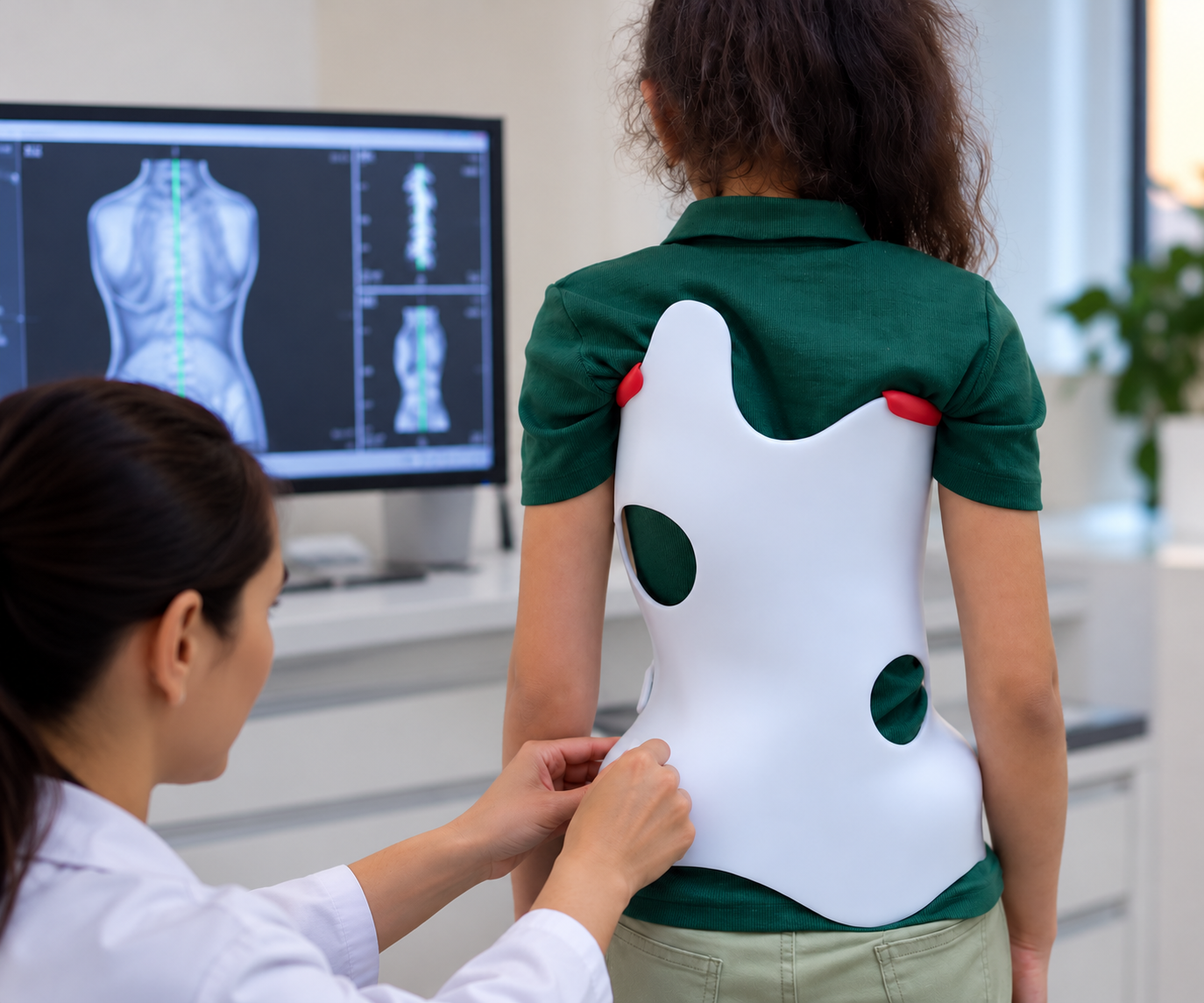
Current international practice regards the custom-made 3D Chêneau brace as one of the most effective forms of conservative treatment for idiopathic scoliosis in children and adolescents who are still actively growing.
At Medicom, every Chêneau brace is made individually, based on a clinical examination, X-ray analysis, 3D body scanning and digital modelling. This approach ensures that the orthosis matches the patient's anatomy as precisely as possible and achieves the most effective three-dimensional correction of the spinal deformity.
Our aim is to stop scoliosis from progressing, correct the existing deformity as far as possible, preserve the natural balance of the trunk and reduce the likelihood of surgery in the future.
Who Is 3D Chêneau Brace Treatment Recommended For?
Treatment is recommended for patients with the following conditions:
- Idiopathic scoliosis in children and adolescents
- Congenital and neuromuscular scoliosis (on a case-by-case basis, where indicated by the doctor)
- A spinal curve with a Cobb angle from 20–25° up to 40–45°, particularly where there are signs of progression.
- The need to prevent the curve from increasing further and to maintain correct spinal balance.
- Skeletal growth that is not yet complete. A Chêneau brace is most effective in patients who have not yet reached Risser stage 4 (Risser 4–5 indicates that skeletal growth is almost or fully complete, at which point bracing becomes significantly less effective).
Every case is assessed individually, taking into account the patient's age, stage of growth, X-ray findings and the specific characteristics of the spinal deformity.
How Does the Treatment Process Work?
-
Free Initial Consultation
Medicom specialists carry out a comprehensive clinical assessment: they listen to the patient's concerns, examine the spine, and assess posture, trunk symmetry and spinal mobility.
-
X-Ray Analysis
We make a detailed assessment of:
- the Cobb angle
- the location of the curve
- the rotational component of the deformity
- the degree of skeletal maturity
- the risk of further progression
- Where necessary, the specialist will recommend additional tests
-
3D Scanning of the Trunk
To make the orthosis, we use modern 3D scanning technology, which produces a highly accurate digital model of the trunk without the need for plaster casts.
This method allows for highly precise modelling, shortens production time and makes the process far more comfortable for the patient.
-
Individual Digital Modelling
Using the results of the clinical examination and the 3D scan data, our specialists design the brace digitally.
The design takes into account:
- the type of scoliotic deformity
- the location of the curves
- the degree of spinal rotation
- the specific features of the rib cage and pelvis
- the patient's individual anatomical measurements
The main goal is to create an orthosis that delivers the most effective three-dimensional correction of the spine while maintaining the level of comfort the patient needs.
-
Brace Manufacturing and Custom Fitting
Once the brace has been made, the patient comes in for a fitting.
Our specialists check:
- that the brace fits correctly
- the effectiveness of the correction zones
- the position of the expansion zones
- the patient's comfort
- freedom to breathe and move
- Where necessary, final individual adjustments are made to the brace
-
Ongoing Monitoring
Scoliosis treatment requires regular medical supervision.
For as long as the brace is worn, Medicom specialists provide:
- scheduled check-ups
- monitoring of treatment effectiveness
- assessment of changes in posture
- adjustments to the orthosis as the child grows
- advice on the wearing schedule and physical activity
Technologies We Use
To produce its 3D Chêneau braces, Medicom uses modern digital technologies that meet international orthotic standards.
In our work, we use:
- 3D body scanning
- CAD/CAM modelling
- digital orthosis design
- three-dimensional spinal correction technology
- modern high-strength thermoplastic materials
- individual computer modelling
Digital technology ensures highly accurate manufacturing, a better anatomical fit and more effective conservative treatment.
Why a 3D Chêneau Brace?
A Chêneau brace is not an off-the-shelf product but a fully custom-made medical orthosis.
Its design is tailored to the three-dimensional shape of each patient's spinal deformity, with the aim of correcting the curve in all three planes.
The main objectives of the brace are:
- preventing scoliosis from progressing
- correcting the existing deformity as far as possible
- restoring the natural balance of the trunk
- improving body symmetry
- reducing the likelihood of surgery
- creating the best possible conditions for the spine to grow correctly
Why Choose Medicom?
- More than 20 years of professional experience
- Every brace made individually
- Advanced 3D scanning technology
- Digital CAD/CAM modelling
- International orthotic standards
- Free initial consultation
- Outreach consultations for patients in remote regions
- Regular follow-up monitoring
- Full support throughout the entire course of treatment
Manufacturing Time
A custom 3D Chêneau brace usually takes 1 to 2 weeks to make.
The length of treatment is determined individually and depends on the patient's age, the severity of the deformity, the stage of spinal growth and how closely the recommended wearing schedule is followed.
Frequently Asked Questions
Can scoliosis be treated without surgery?
In many cases, starting treatment with a custom Chêneau brace at the right time can stop the condition from progressing, significantly reduce the curvature and avoid the need for surgery.
How many hours a day does the brace need to be worn?
The wearing schedule is set individually by the treating specialist. In most cases, the orthosis is recommended for 18 to 23 hours a day, depending on the clinical situation.
How comfortable is a Chêneau brace to wear?
Modern digital manufacturing makes it possible to create a brace that follows the body's contours as closely as possible, providing effective correction with a high level of comfort and minimal restriction on everyday activities.
Can patients play sport during treatment?
Yes. Most patients are advised to stay physically active and to do the specialised exercises prescribed by their doctor or rehabilitation specialist.
How is the effectiveness of treatment monitored?
Effectiveness is assessed through regular clinical examinations, follow-up X-rays, analysis of changes in posture and tracking of the child's growth.
How is the cost of the brace determined?
The cost is calculated individually and depends on the clinical picture, the complexity of the deformity and the design features of the orthosis.
That is why the initial consultation, clinical assessment and treatment planning at Medicom are free of charge.